Posts

Eighty years ago the fall of Tobruk brings Churchill humiliation and the promise of better tanks

Image
  Churchill travelled again to Washington to talk to President Roosevelt. Unlike their other meetings no codename was given to this one as the discussions between delegations of military leaders were the principal forum and the summit conversation was treated as informal. The talks focused on helping the Soviet Union; there was no firm conclusion on coordinating military strategy. Churchill resisted US enthusiasm for an invasion of the Continent even as early as later that year. Churchill steered the Americans towards joint operations in the Mediterranean. Whilst he was in Washington Churchill had the mortification of learning that Tobruk had fallen to Rommel's advancing Axis troops after they had breached the British Gazala line leaving the fortress isolated. The South African and British garrison held out for only three days before surrendering with  33,000 men. It was the last and, possibly, the most bitter in the string of military humiliations suffered by Britain since th...

Eighty years ago a German reprisal for the killing of Reinhard Heydrich gives the world a shorthand for Nazi evil

Image
  The Germans enacted an especially atrocious reprisal for the killing of Reinhard Heydrich on direct orders from Hitler. The target was a mining village with 500 inhabitants, Lidice, near Prague. All the males over 15 were shot by ordinary German policemen; most women and children were sent to concentration camps but a few children were adopted by SS families. The other children were gassed and only about half the women survived. The village was razed to the ground. The evidence that anyone from Lidice was involved in Hydrich's death was tenuous and probably inaccurate, but the Germans wanted a conspicuous deterrent to any support for the resistance. The crime was announced publicly, establishing the name Lidice as a byword for Nazi evil. The transportation of 3,000 Jews to extermination camps in trains marked "AaH" ( Attentat auf Heydrich ) in revenge for the killing was a matter almost of routine and passed largely unremarked. Under the overall codename Operation Juliu...

Eighty years ago the US Navy inflicts a crippling defeat on the Japanese fleet six months after Pearl Harbour

Image
  The US Navy defeated the Imperial Japanese Navy (IJN) decisively at the Battle of Midway. The battle marked a number of milestones: code-breaking gave the Americans a clear advantage, cryptanalysis had truly come of age; the significant action was undertaken by carrier-based aircraft, the major surface units never saw each other; the last major thrust of the Japanese attack on the US and its possessions was utterly defeated; the IJN did not merely lose more carriers than the USN, Japan did not have the industrial capacity to replace them quickly, in an illustration of the fatal economic disparity between the two nations. The US Navy's code-breakers had revealed that the IJN planned to seize Midway Island from which it would have been able to menace Hawaii, so Admiral Nimitz could confidently concentrate his carriers to oppose it. All four Japanese carriers with 300 aircraft and 200 invaluable pilots were lost, whilst only the USS Yorktown was sunk. Only six months after Pearl Har...

Eighty years ago the RAF's cherished project of winning the war by bombing comes of age

Image
      RAF Bomber Command launched Operation Millennium , an attack on Cologne by just over one thousand bombers, a force almost three times as large as it had deployed on a single operation before. To field this number of aircraft the head of the Command 'Bert' Harris had to use training units; to Harris's fury the Royal Navy refused to allow Coastal Command aircraft to be used. Harris failed to recognize the vital importance of the Battle of the Atlantic and was to describe Coastal Command as an "obstacle to victory." Millennium had a double propaganda purpose: to give the British public, inured to a series of military reverses, news of a massive offesnsive operation against the Germans; to demonstrate at the highest level of military command that the RAF was finally capable of accomplishing the strategic bombing mission with which the service had been obsessed for almost its entire existence. Cologne city centre was devastated but the damage to military or war i...

Eighty years ago a Free French brigade frustrates Rommel's attack

Image
  The Axis forces in North Africa under General Rommel launched a major offensive against the British-led armies in what came to be called the Battle of Gazala. The attack was almost immediately held up by a factor that Rommel had not anticipated: strong resistance by the Free French brigade including many volunteers from France's African colonies, garrisoning an old Ottoman fort at the oasis of Bir Hakeim which anchored the allied left wing. This was the first major engagement by Free French ground forces and is widely commemorated, most notably in the name of a bridge across the Seine in Paris. The Soviet attack on Kharkov failed in a severe defeat for the Red Army. Confronted by well-led German forces and almost complete air superiority the initial move was brought to a standstill and counter-attacks encircled the Soviet 6th and 57th armies. These were anihilated with the loss of almost 300,000 men. The only consolation for the Soviets was that these casualties were smaller than...

Eighty years ago, before the Wagatha sting there were the code-breakers of OP-20-G

Image
    In a stroke worthy of Coleen Rooney, the US Navy's code-breakers resolved a furious debate over where the next Japanese stroke would be directed. The JN-25 cypher had been broken and revealed that "AF" was the next target, but the USN high command was convinced this meant the Aleutian Islands in the north Pacific, but the code-breakers of OP-20-G believed it was Midway Island in the central Pacific. Code-breaker Jasper Holmes had the inspiration of instructing the Midway garrison to send an emergency plain language message saying that the island's desalination plant had been wrecked. The Japanese duly signalled in JN-25 that "AF" was short of water, putting it beyond doubt where they were going to attack. The Soviet forces that had landed on the Kerch Peninsula in Stalin's scheme to relieve the siege of Sevastopol were in increasingly dire straits, entirely cut off and dependent on sea supply for everything. They were doomed when the Germans launched...

Eighty years ago the British risk compromising Ultra intelligence to ward off gas warfare on the Eastern Front

Image
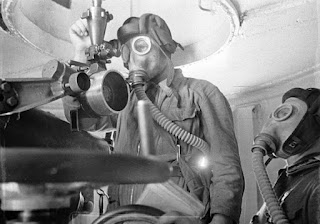
Rumours that the Germans might use poison gas on the Eastern Front had been common for some months. The Soviets expressed their concern to the British; it was a topic on which they were unusually forthcoming. Churchill privately informed Stalin that he would treat the use of gas against the Soviets as though it were being used against Britain. GCHQ decycphered an ambiguous and non-urgent messsage suggesting that a gas attack might be under preparation. This was enough for Churchill to give the same commitment in a public speech that he had given confidentially. In practice he was warning Hitler that the RAF would drop gas bombs on German cities in retaliation. The British were worried enough at the possibility that either side might use gas on the Eastern Front to risk compromising the secrecy of Ultra intelligence. The US Navy concentrated its aircraft carriers to blunt a Japanese thrust into the Coral Sea that threatened  the vital port of Port Morseby on New Guinea, which could ...