Posts

Eighty year ago this week, RAF Bomber Command finally begins to carry out the mission it set itself in 1938 and visionarily-led special forces counter-balance conventional military failure in Burma
Image
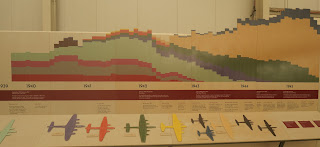
  RAF Bomber Command mounted its largest raid of the war by weight of bombs, dropping 2,000 tons on the city of Dortmund as the campaign that came to be called the Battle of the Ruhr got under way. Its previous record was 1,500 tons a few weeks before. The  Command's destructive power had grown because the 1938 Scheme M programme of migrating to an entirely heavy bomber force was finally becoming a reality. Twin-engine Vickers Wellingtons still featured largely in its arsenal, but four-engined Lancasters and Halifaxes were taking over. The first Chindit operation, Operation Longcloth,  behind Japanese lines in Burma was announced publicly. The tale of bravery and inventiveness served as a counterweight to the embarrassing news of the failure of the Arakan offensive. Militarily it achieved almost nothing against the Japanese and only half of the 3,000 troops committed had survived in fit state for future combat. The Chindits and their visionary commander, Orde Wingate, fit...

Eighty years ago this week, British church bells ring for victory in Tunisia and a legend is born

Image
    The last pockets of Axis troops in Tunisia were overrun and the commanding generals von Arnim and Messe were taken prisoner. All told some 200,000 Germans and Italians became prisoners of war. Church bells were rung throughout England to celebrate the victory, the seond occasion that this had happened in the Second World War; the first had been for el Alamein. The RAF carried out an operation that had been under consideration since the early days of the war: attacking the Ruhr dams by bombers. At the cost of eight out of 19 aircraft despatched the newly formed 617 Squadron destroyed two of the four dams attacked. Hydroelectric production was severely disrupted but no attempt was was to interfere with the rebuilding of the dams. Of the 1,600 fatal casualties on the ground, about two-thirds were Soviet prisoners and slave labourers. SS General Juergen Stroop presonally triggered the explosion that destroyed Warsaw's great synagogue to mark what he presented as the final supp...

Eighty years ago this week the British army tastes triumph in Tunisia and humiliation in Burma

Image
    Within minutes of each other the British Eight Army and the US II Corps respectively took the major Tunisian cities of Tunis and Bizerte. Three German  divisional  commanders were amongst the tens of thousands of prisoners taken. Only  a small Axis redoubt on the Cape Bon peninsula held out. Militarily the North African campaign was practically over. In Burma the British put an end to the sorry fiasco of the Arakan offensive. The attack had been premature and ill-planned. General Irwin, the front commander,  wanted to hold on on to the small port of Maungdaw as a token gain to mask the debacle, but General Slim, on whom Irwin had dumped the conduct of the campaign once his initial strategy had failed, told him firmly that the town was indefensible and of no strategic value. Slim prevailed and the British retreated into India. Churchill who had just arrived in Washington for a conference with Roosevelt was furious at another British failure, which seeme...

Eighty years ago a brutal convoy battle marks a turning point in the Battle of the Atlantic and the US Army comes of age in Tunisia

Image
  The battle of convoy ONS 5 marked a turning point in the Battle of the Atlantic. Admiral Doenitz was able to field about forty U-Boats to attack the slow, westbound convoy of 42 merchantmen. The British, though, had intelligence of all his moves and had sufficient warships to  deploy 15 escorts albeit not all simultaneously. Atrocious weather prevented refuelling warships at sea. The U-Boats sank no less than 13 of the merchantmen but lost seven of their number, with a further seven badly damaged. It was not a sustainable rate of exchange. In a hard-fought battle the US 43 Division, which a few weeks before had been classed as unfit for combat, dislodged the Germans from Hill 609, the last significant terrain feature protecting their enclave around Tunis. The operation had been intended as a minor holding action but now opened the way for the final elimination  of the Axis from North Africa. It also showed that the US Army had come of age operationally although the perc...

Eighty years ago the Soviets launch a decades long campaign of denying their crimes but the Japanese boast of theirs

Image
    The Soviet regime broke off diplomatic relations with the Polish government-in-exile because it refused to endorse the transparent Soviet fiction that the 10,000 Polish officers and other elite killed at Katyn Wood had been murdered by the Germans. The Poles sought an investigation by the Red Cross into the crime. The Germans had announced the discovery of the corpses some days beforehand. The Soviet explanation was seen as a sign of guilty conscience and a gift to German propaganda. Only in 2010 did the Russian parliament formally admit responsibility. Japan announced openly that it had carried out illegal death sentences on US aircrew from the Doolittle air raid the previous year who had fallen into their hands. Eight had been sentenced to death supposedly for intentionally attacking civilian targets, but five of these sentences were commuted.  The British Eighth Army captured Longstop Hill, the last major terrain feature protecting the Axis enclave in Tunisia. In D...

Eighty years ago this week Admiral Yamamoto and the German attempt to resupply Tunisia fall victim to Allied command of the air.

Image
  The Japanese navy commander Admiral Isoroku Yamamoto was killed when his aircraft was shot down by US Air Force P-38 fighters in a targeted operation. A combination of US code-breaking and poor Japanese security had disclosed the precise schedule of the admiral's tour of inspection. The full chain of decisions that led to the mission is unclear, but the most plausible version is that the USN commanders immediately present made the the decision and informed Washington. Yamamoto had planned the Pearl Harbor attack so revenge featured as a motivation but the killing hit Japanese morale and deprived them of a highly competent commander. Fittingly the P-38s, the only aircraft with sufficient range for the operation, had just moved to Guadalcanal safely in US hands after an epic struggle. Just as the Germans had attempted in the Stalingrad pocket, the beleaguered Axis forces in Tunisia could only be supplied by air, because the allies had achieved practical control of the Mediterranean...

Eighty years ago Bormann steps out from the shadows and Montgomery has another triumphal entry

Image
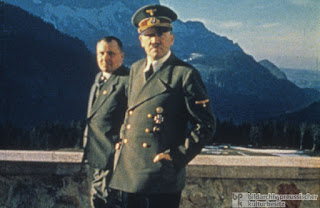
  Martin Bormann was publicly given the title "Secretary of the Fuehrer" although this had long been his job. He had already used his control of access to Hitler to make himself the second most powerful man in the Reich. This had been clear to insiders for some while but had passed unnoticed amongst the allies; Bormann cultivated an image of near-invisibility and was rarely photographed. The open acknowledgement of Bormann's status was acutely felt by Goebbels who understood that his previously intimate relationship with Hitler was being diluted. Lead elements of Patton's II Corps advancing into Tunisia from the West joined with  Montgomery's 8th Army coming from the East. The junction had symbolic but little military importance; only desert lay to the south. The allies were poised for the final drive to Tunis and Montgomery could treat himself to another triumphal entry into a conquered city, the port of Sfax. The British coalition government suffered a surprise ...