Posts

Showing posts from 2022

Eighty years ago the Red Army raids an airfield deep in the German rear

Image
    The Red Army staged an audacious deep penetration attack in corps strength aimed at the major German airfield hub at Tatinskaya over 200km from its supply base. The Soviets broke through to the airfield so rapidly that air operations were still in progress when they arrived. Approximately 200 operational aircraft were destroyed, some reportedly by being rammed by Soviet tanks. This gravely compromising the Luftwaffe's already tenuous capacity to supply the forces trapped in Stalingrad by air. The 150 or so tanks and other heavy equipment commited to the operation were lost but it was a considerable strategic success. Allied ground forces in Tunisia had reached sufficient size for their commanders to stage another push against the Germans. The Coldstream Guards led the assault with an attack on Longstop Hill against stiff German resistance. The Coldstreamers were relieved by the US 18th RCT when they took the first summit but a counter attack dislodged the Americans. The Co...
Eighty years ago the British and Americans finally condemn German extermination of Jews

Image
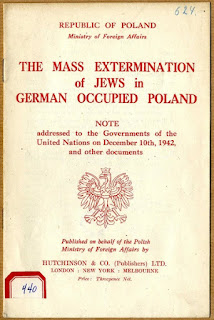
  The British government finally departed from its non-commital attitude towards the Nazi attempt to exterminate the Jews throughout occupied Europe. In response to a report from the Polish government-in-exile the Foreign Secretary delivered a declaration on behalf of the United Nations, chiefly Britain and the US, condemning the Nazi programme and promising punishment of those responsible. At the suggestion of Labour MP William Cluse the House stood up in silence, a gesture usually reserved to mark the death of a sovereign. British forces crossed back into Burma in what was presented as a return to the offensive after being routed by the Japanese erlier in the year. The objective was relatively unambitious: to establish a foothold on the Arakan peninsula including seizing the island of Akyab. The attack faced weak opposition but the omens were not good. The British commander Noel Irwin was on poor terms with the commander of neighbouring forces, Bill Slim, and determined to...

Eight years ago Britain re-starts treating its captives well, Germany doesn't

Image
  The German 4th Panzer Army under Manstein launched operation Winter Storm, to try a break through the Soviet forces surrounding General von Paulus's 6th Army trapped in Stalingrad. The offensive made some gains but ran out of momentum and the Red Army counter-attacked the Axis left flank, overwhelming by the Italian 8th Army. Hitler refused Manstein's request for Paulus to try to break out of Stalingrad; Paulus himself was reluctant. The threat to disregard the Geneva Convention in respect of German and British PoWs triggered by the shackling of captives in a commando raid proved to be short-lived. The Swiss government proposed to both sides that they discontinue shackling prisoners in camps. The British and Canadian governments almost immediately announced their agreement and restraints were removed from German PoWs. Whilst Germany and Britain reverted to treating their uniformed, regular  military captives in civilized fashion, no such consideration was being shown to civi...

Eighty years ago, France acquires a fourth would-be leader

Image
  France acquired its fourth would-be national leader when Admiral Darlan declared that he was the head of government. It was only by chance that he had found himself in French North Africa as the senior figure of the Vichy regime when the allies invaded so it was not hard to question the legitimacy of this piece of self-promotion. Darlan had done a private deal with General Eisenhower under which he had already promoted himself High-Commissioner and instructed Vichy forces to cease fire. It also put off the evil day when a choice would have to be made between General Giraud, the Americans' choice but almost no-one else's, and General de Gaulle, who controlled the French French armed forces. Marshal Petain remained the figurehead of Vichy. The German forces trapped in Tunisia began to put up a stiff resistance to the allied advance from Algeria. The had just been reinforced by the 10th  Panzer Dvision, which mounted a counter-attack forcing the allies to retreat to strong def...

Eighty years ago the blueprint for the Welfare State is published

Image
    One of the objectives of the Germans invasion of the previously unoccupied zone of France was to seize the powerful fleet at anchor in Toulon in Operation Lila. This was explicitly forbidden by the terms of the armistice, but the French Navy was not naif and still made plans to scuttle the fleet if the Germans attempted to seize it. The commander Admiral Laborde could not, though, be persuaded to sail the ships to join the shadow Vichy authorities in North Africa so the scuttling plan was put into operation when the Germans assaulted the dockyards. It succeeded and three battleships, seven cruisers, fifteen destroyers and numerous smaller vessels went to the bottom. The Vichy government lost thereby its final shred of bargaining power. The only ever significant, but still tiny, battle was fought between forces of de Gaulle's Free French and Vichy French units over the island of Reunion in the Indian Ocean. The destroyer Leopard landed a company of marines and the island w...

Eighty years ago the Soviet encirclement of the Germans in Stalingrad crowns a fortnight of decisive strategic victories against the Axis

Image
  The Red Army launched Operation Uranus : two thrusts in each direction along a straight axis north-west to south-east. Within days the two thrusts met after each advancing approximately 250km, cutting off the German forces still fighting in Stalingrad. The speed with which Uranus succeeded demonstrates just how thinly spread Axis forces had become as the advance on Stalingrad dominated their operations. The Germans had finally paid the penalty of strategic over-reach; the Soviets had  used their enormously superior strength to transform the German Case Blue from a supposedly decisive offensive into a fight for survival. The 200,000 or so men trapped in the pocket were doomed. The Allied victories in North Africa brought a strategic dividend when the Operation Stoneage convoy ran from Alexandria to Malta  almost unscathed, apart from severe damage to a cruisier of its escort. This was a dramatic reversal of the position in August when Axis forces around the Mediterranea...

Eighty years ago a naval battle seals the fate of the Guadalcanal campaign

Image
  The Naval Battle of Guadalcanal also goes by other names but it was the decisive sea battle of the campaign. The Japanese were attempting to run a convoy carrying 7,000 or so reinforcement troops to the island with a large escort; other vessels were also to shell the US positions around Henderson Field. US intelligence alerted the navy. The Japanese had the better of the first of two night engagements  but they were still forced to postpone the bombardment by one day. More important the Japanese convoy was badly mauled by aircraft from Henderson and the carrier USS Enterprise , which was not fully repaired from its last battle but was the USN's only available carrier. Damaged Japanese transports had to be beached and only 2,000 troops made it ashore. In the second surface battle the Americans forced the Japanese to withdraw. The other register of American success is that they brought a similar sized convoy to land with minimal loss. The forces were roughly equal in strength...

Eighty years ago the allies win incomplete victories in North Africa

Image
  Axis resistance to General Montgomery's attack at El Alamein collapsed completely in the face of massive superiority of the British led forces and Rommel went into full retreat. Montgomery proved to be the 'lucky general' who reaped the rewards of the allies vastly greater economic resources, whilst the reputations of his predecessors who had far less to work with were flayed by Churchill. Montgomery was knighted immediately in recognition of the victory. Churchill saw a turning point but knew that there was still much to do, "Now is not the end. It is not even the beginning of the end. But it is, perhaps, the end of the beginning." President Franklin Roosevelt had always recognized that it was the European war that demanded the higher priority than the Pacific War and this strategy became a public fact when massive American forces invaded Vichy France's North African territories in the Torch landings. They encountered some military opposition but this was ...

Eighty years ago in deep secrecy the battle against Enigma turns for the better

Image
  In the Mediterranean the U-559 was hunted down by British ships and aircraft. She was fatally damaged and abandoned by her crew. They neither scuttled her properly nor destroyed her confidential material. Three men from the destroyer HMS Petard boarded her and retrieved documents including the current Enigma setting sheets, which were passed to a whaler from Petard . This provided crucial material to advance GCHQ's work in breaking the cypher, which had resisted their efforts for ten months. By some measures this marked the turning point in the intelligence battle against the U-boats. Two of the boarding party were caught on the submarine when she sank and drowned. They were awarded George Crosses; by some accounts awards of Victoria Crosses were rejected because these might have drawn too much attention to the value of their sacrifce. The award citations were bland and unspecific. A public meeting at the Albert Hall led by senior British churchmen protested against Nazi persecu...

Eighty years ago the British can finally field decent (American made) tanks in North Africa

Image
   The British Eight Army under the recently appointed General Montgomery launched a full-scale attack on Axis forces in Egypt in the second battle of El Alamein. The British led forces enjoyed a near two to one superiority in almost all respects. After years of fighting with mediocre or inferior quality tanks, they also had 300 of the new Sherman M-4 tanks that President Roosevelt had diverted from the US Army and which were reliable and more than the equal of most German or Italian tanks. The fight for Guadalcanal reached its most intense point with battles on both land and sea. The Japanese massed the troops for a major assault on the Americans, triggering three days of intense fighting. Their attacks came close to threatening the American perimeter but none succeeded. The desperation of the Japanese assault is obvious from the 2,000 to 3,000 killed compared to fewer than one hundred Americans. Each side had some 20,000 troops in the field: a small number compared to the fo...

Eighty years ago the Germans win an empty propaganda prize in the battle for Stalingrad

Image
  After fierce fighting the Germans occupied the Stalingrad Tractor Plant. Or, more accurately, its ruins. The position had little operational significance in the battle for the city, but great propaganda resonance. Its output of tractors had been a key element in the much-touted modernisation of agriculture under the Soviets and the industrialisation of the USSR although it had been switched to tank production on the outbreak of war. It had also been named after Feliks Dzerzhinsky, one of the spiritual fathers of the Soviet state, as the founder of the Cheka and the OGPU, the predecessors of the KGB and today's FSB. A large statue of Dzerzhinsky still stands on the site. The Red air force accomplished one of its occasional humanitarian missions when it evacuated thirteen monkeys from the research institute founded by Professor Ivan Pavlov in the beleaguered city of Leningrad, where they had been suffering from shortage of food in common with the city's human inhabitants, but ...

Eighty years ago government campaigns against political dissent and profiteering find a perfect target

Image
  The ghost of profiteering on war contracts that had been a great topic in the First World War resurfaced, this time intertwined with the government's campaign against political dissent. The Commons Public Accounts Committee savagely criticized the British Research and Manufacturing Company (BMARC), a subisdiary of the French Hispano-Suiza company established before the war to manufacture vitally needed 20mm cannon for the RAF. Analagous to the Holy Roman Empire, BMARC was neither Swiss, Spanish nor a research company; its sin was to have supplied weapons under fixed price contracts so lucrative that an initial profit of £1.7m had to be pared down to £90,000 on re-examination. BMARC charged £280 for weapons that cost £168 to produce. BMARC was an attractive target as its managing director, Dennis Kendall had recently been elected as an independent MP against the government candidate. Whilst most of the awkward squad MPs belonged to the extreme wings of coalition parties, Kendall w...

Eighty years ago the start of the era of ballistics missiles

Image
  After two failed attempts, the German A-4 rocket, orginally developed for the army as a form of long-range artillery, achieved an entirely successful launch. It travelled 190km from the Peenemuende test centre reaching an apogee of 85km before splashing down in the Baltic. The age of the ballistic missile had begun and, better known as the V-2 (for Vergeltung or revenge), the A-4 would soon become a major preoccupation for the British authorities as they received intelligence of its development. Hitler delivered one of his increasingly rare public speeches at the  Sportpalast to mark the opening of the year's edition of the  Winterhilfe  campaign, one of the key dates in the Nazi calendar. He gave a comprehensive and detailed account of how he saw the war was developing including his habitual sneers at Winston Churchill. He also reminded his listeners of his prophecy that the Jews, who he claimed had wanted the war, would be exterminated. The speech was extensivel...

Eighty years ago the RAF begins its war on the Gestapo with a new weapon

Image
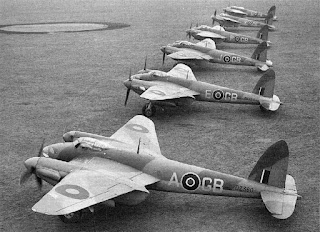
  Four of the RAF's recently introduced Mosquito bombers from 105 Squadron attacked the Gestapo headquarters in Oslo. The operation was timed to disrupt a speech by Vidkun Quisling, the collaborationist national leader, and boost the morale of occupied Norwegians. Quisling supposedly took shelter whilst the raid was in progress but it failed to destroy its target. Some bombs passed clean through the building and exploded causing some eighty Norwegian civilian casualties. One Mosquito was shot down. Despite this lacklustre result, the attack was deemed worthy of extensive publicity; it was the first time that the Mosquito was mentioned publicly. The raid was the first of a number of attacks all delivered by Mosquitoes against German security forces targets.   The labour shortage in British industry was biting, above all in the coal fields the only significant domestic source of energy. It is a good register of how unattractive (and dangerous) working underground was, that the r...

Eighty years ago the last trace of chivalry is expunged from the U-boat war

Image
  U-156 sank the British liner Laconia in the South Atlantic. Chivalrously the German captain tried to rescue the survivors, taking some onto his boat's casing and towing lifeboats. He also broadcast over an open frequency announcing that he was taking the survivors to be transferred to Vichy French ships. The Allies were more ruthless and the U-156 was bombed by a B-24 even though it was flying a Red Cross. Another U-boat that attempted to assist was also attacked. 1,700 mostly Italian PoWs were killed but 1,000 were saved. The German commander Admiral Doenitz issued a direct order that his U-boats were to refrain from such humanitarian acts. After the debacle of convoy PQ17, which had drawn direct criticism from Stalin,  the British took advantage of lengthening nights to run another convoy to the Soviets through the Arctic. There were forty merchant ships in PQ18 and an impressively strong close escort of about the same number of warships that included HMS Avenger an escor...

Eighty years ago the British find the limits of raiding possiblities in North Africa

Image
  The British launched a number of simultaneous but unconnected attacks on the Axis rear area in North Africa. The initiative appears to have come from special forces HQ in Cairo with the goal of causing major disruption. Progressively even military bureaucrats had been converted to the attractions of special forces operations, but this had bred exaggerrated hopes. The most ambitious was a land and sea attack on Tobruk. The land element was disguised as a convoy of prisoners under German (in reality Jewish emigres of the Special Interrogation Group) escort. The raid failed catastrophically with over one thousand killed or PoW and the sinking of a cruiser, two destroyers and a number of light craft by the Italian navy and air force. The leader Colonel Haselden was killed. Apart from a successful raid on an Italian airfield at Barce by the LRDG none of the other elements succeeded. A large-scale attack on Benghazi by the SAS was detected early and aborted. An attempt to sei...

Eighty years ago Vichy introduces labour conscription on behalf of the Germans

Image
Having struck a bargain with the Germans under which 50,000 French prisoners of war would be liberated in exchange for France supplying 150,000 workers to Germany, the Vichy prime minister Pierre Laval had to find a way of delivering his end of the deal. Fewer than 100,000 workers had gone to Germany voluntarily before then. Vichy passed a law creating the service du travail obligatoire under which all able-bodied males between 18 and 50 and single women of 21 to 35 were forced to do any work that the government deemed to be necessary: in practice going to Germany as quasi-slaves. In practice the law was never applied to women because of the scale of protest it would have aroused especially from the church, but it was enforced on men and became arguably Vichy's least popular measure, a key factor in destroying whatever support the regime had enjoyed. Nineteen year old Tom Williams became the last IRA man to be hanged for murdering a (Catholic) RUC constable earlier tha...

Eighty years ago the appeasement of Stalin continues

Image
Britain might not have been able to satisfy Stalin's demands for military assistance by invading France, but it could continue to appease him domestically. The Communist Daily Worker newspaper had been banned for its ferevently anti-war stance during the period of the Ribbentrop/Molotov pact. Obedient to Moscow, the CPGB had swung in favour of the war after Barbarossa but the ban was not lifted. The Labour Party, notably Home Secretary Herbert Morrison, detested the Communists, but finally a campaign led by naive soviet supporters such as scientist  J.B.S Haldane and the Dean of Canterbury swung the Labour Party in favour of the Daily Worker . The ban was removed. Helped by Ultra intelligence of German plans, the Eight Army under its new commander Bernard Montgomery, was able to hold off Rommel's last attempt to breakthrough into Egypt at the battle of Adam el Halfa. Montgomery deliberately lured Rommel's thrust into a gap in the south of his line but the Germans then enco...

Eighty years ago the British take an expensive lesson in how to conduct an assault landing

Image
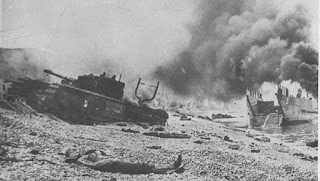
  In a year of almost unrelieved military failures the British had been able to take comfort from a series of amphibious attacks on German-held France and the growing effectiveness of the bomber offensive against Germany. They now proceeded to over-reach themselves with their most ambitious amphibious raid by far. With the memory of Stalin's abuse to Churchill of British resolution in Moscow a recent memory, they finally mounted a much postponed brigade strength attack on the port of Dieppe devised by Combined Operations . It fell well short of the 'Second Front' desired by Stalin, but should have demonstrated that the British were capable of a major cross-Channel attack. Operation Jubilee was a dismal failure and achieved almost none of its objectives. A sea-wall familiar to generations of travellers, prevented British tanks from joining the battle in the town. The attackers lost more than half of the men landed, 3,500 as casualties and 2,000 as POWs. Part of the plan had...