Posts

Showing posts from 2023

Eighty years ago Eisenhower is appointed supreme commander of Overlord acknowledging US primacy in the war effort

Image
  President Roosevelt announced that General Dwight Eisenhower would have supreme command of the allied invasion of Europe in 1944. He had been chosen as much for his diplomatic as his military gifts; his status as commander of the British forces involved, most especially the willful General Montgomery, would have to be handled with great tact. Most of his immediate subordinates were British. His appointment set the seal of public recognition on US predominance in the war effort. Distasteful though it was to many British people, the US was the senior partner in the alliance already contribtuing larger forces and hugely greater industrial resources. In the last major naval engagement fought purely between surface vessels, the Scharnhorst was sunk in the Battle of North Cape. She was heavily shelled by the battleship Duke of York and cruiser Belfast then finished off by torpedoes from destroyers. The British had the advantage of accurate intelligence on her movements and greatly s...
Eighty years ago this week the allies make only slow headway against the Germans in the Ukraine and in Italy

Image
  The northernmost of the sequence of German defensive "winter" lines in Italy rested on the Adriatic port city Ortona. The crossing of the Sangro futher south had been relatively easy but the Germans defended Ortona ferociously against the Canadian 1st Infantry Division. The house-to-house fighting was especially bloody and Ortona came to be called the Stalingrad of Italy. After liberating Kyiv the previous month, the Red Army was subjected to a ferocious German counter-attack. The Soviets were able to send urgent reinforcements to the front which halted the Germans but the two armies had fought each other to a standstill. Each had suffered heavy casualties but neither had achieved a major strategic victory in which major opposing formations were eliminated. The German army was firmly on the back-foot but still a formidable opponent. RAF Bomber Command suffered what came to be called Black Thursday when it mounted a raid on Berlin as part of AM Harris's campaign to destr...

Eighty years ago this week Turkey fails to rise to Churchill's bait

Image
      The Turkish president Inonu met Roosevelt and Churchill in Cairo. The British flooded the media with reports suggesting that Turkey would soon be coming into the war on the allied side but these were spurious. Churchill entertained fantasies that  Turkey's entry into the war would revive his scheme for a full-scale attack on the Balkans which had been scotched by the active opposition of Stalin and the scepticism of Roosevelt at the Teheran conference. In reality Turkish neutrality was a sounder option for all concerned. German divisions were tied up protecting Bulgaria from opportunistic seizure by Turkey. Providing the Turkish armed forces with modern equipment would have drained allied resources for no immediate benefit. The Czechoslovak government-in-exile signed a treaty with the Soviet Union grandiloquently named Treaty of Friendship and Mutual Collaboration. The Czechs hoped to escpe the fate of Poland where the Soviets were running their own alternative...

Eighty years ago this week Stalin receives the tribute of George VI

Image
    Churchill personally presented the 'Sword of Stalingrad' to Stalin at the Soviet embassy in Teheran in front of dignitaries and a military guard from each nation. The sword was a gift of George VI honouring the people of the city for their resistance; it had become an emblem of the intense sovophilia across British society which Evelyn Waugh later derided in his Sword Of Honour trilogy. Both leaders were visibly moved and Stalin kissed the sword. However Stalin and his interpreter spoke so inaubly that no-one could understand what he meant to say. Supposedly he expressed the deep appreciation of the Russian people for the honourable gesture of their British comrades. The acute shortage of labour for the mines could not be solved by voluntary measures and the Minister of Labour Ernest Bevin announced that there would be compulsion. One in ten men drafted into service would be sent to the mines rather than the armed forces. The men would be chosen by ballot. They would be p...

Eighty years ago this week Stalin begins to reshape post-war Europe

Image
  For the first time since becoming dictator of the Soviet Union, Stalin left its territory, albeit only to travel the short distance to  Teheran which had been under Soviet occupation since the previous year. The summit meeting with Roosevelt and Churchill discussed the invasion of France to which the US and Britan were now committed in 1944.  Stalin's vision of the post-war world was endorsed by the agreement to transfer much of eastern Poland to Soviet republics; Poland would be compensated by redrawing its western frontier at the expense of Germany. Stalin commited himself in principal to declaring war on Japan once Germany was defeated. In all the Stalin-inspired clamour for a second front, it had been sedulously ignored that Britain and the US were shielding the Soviet eastern frontier by their campaigns against Japan. The preparation for the debate on the King's speech to Parliament provoked a flurry of proposed amendments to the government's programme. The...

Eighty years ago RAF Bomber Command launches the Battle of Berlin

Image
  What came to be known as the Battle of Berlin got properly underway with raids on four nights: 440 RAF aircraft in the first, then 764 bombers two days later, followed the next night by one of 383 and three nights later,  443 Lancasters. After the devastation wrought on Hamburg that summer Bomber Command had staged one large raid in August, but its commander, Air Marshal Arthur Harris, was determined to obliterate the whole city, which he believed would win the war for the allies. He was prepared for a campaign that would involve several raids and the loss of 300-400 of his aircraft. 123 were lost in the November raids, a loss rate of 4.9%, heavy but sustainable. A total of  some 7,000 tons of bombs were dropped, killing perhaps 3,000 people and ravaging most of the city's central district, destroying or severely damaging many famous buildings including the Kroll Opera House which had housed the German parliament since the Reichstag was burned out in 1933. The US began ...

Eighty years ago this week the folly of Britain's Dodecanese campaign comes to a miserable end.

Image
  German amphibious and airborne forces landed on Leros in the Dodecanese which the British had persisted in occupying despite the fall of Kos with its airfield in September, which gave the Germans practical air superiority. This was practically the last significant parachute assault conducted by the Germans in the war. The British and their Italian allies held out for four days before surrendering. 3,200 British and  5,350 Italian soldiers were captured for no results whatever. The remaining islands were quietly evacuated. Churchill had hoped that the Dodecanese campaign would bring Turkey into the war on the allied side, instead it was a major loss of prestige for Britain in the Mediterranean.   The Japanese navy had gathered a powerful force based around seven cruisers at the well-defended base of Rabaul on New Guinea. This menaced the US forces which had recently landed on Bougainville as a prelude to an attack on Rabaul itself. The US Navy responded with a strike...

Eighty years ago this week Hitler promises retribution on England

Image
On the twentieth anniversary of the failed beer hall putsch, Hitler delivered what proved to be his last speech commemorating the event, one of the principal festivals in the Nazi calendar. He assailed England as the principal driving force in the war and as a pawn of the Jews. He hinted at the pending use of secret weapons when he told his listeners that the hour of retribution ( Vergeltung ) "will" come. America might be out of reach for the moment but one state - obviously Britain - was. Here is the origin of the term V-weapons. He described himself as profoundly religous, albeit because he cast himself and the German people as having been chosen by "providence" for greater things. The Ukrainian capital Kyiv (then known by the Russian name Kiev) fell to the Soviets as part of a wider offensive on the southern front.  The German VII holding the city was forced to retreat under massive attack; there was no significant fighting in the city itself. Radio Moscow anno...

Eighty years ago this week the noose tightens on Rabaul

Image
    American led forces in the South West Pacific launched the next steps in Operation Cartwheel, which was intended to eliminate the major Japanese base at Rabaul. US forces landed on the island of Bougainville with the ultimate objective of establishing an airfield for short range aircraft to attack Rabaul. Just to the north a New Zealand brigade landed on the Treasury Islands which were to serve as stepping stones for the ultimate assault; one was slated as the site for a radar base. A Japanese naval force was despatched to hamper the Bougainville operation but the transport ships for the first wave had unloaded rapidly and been withdrawn. In turn a US Navy force engaged the Japanese ships in a night action where their radar gave them a decisive advantage. The Japanese withdrew after losing two ships and damage to two more. The US build-up could continue practically unopposed. The installation of Lord Wavell as the Viceroy to India brought attention in Britain to the burgeo...

Eighty years ago this week Britain's Aspidistra transmitter attacks German morale and night-fighter control

Image
    The British black propaganda radio station Soldatensender Calais (Calais soldiers' station) made its first transmission. It was part of the Political Warfare Executive and used the high power Aspidistra transmitter to send a clear signal, primarily to occupying troops in France but it was also popular in Germany. It was run by the gifted propagandist Sefton Delmer and presented itself as an official German station, even broadcasting speeches by Hitler. Amongst its attractive programming of light music and sports news, it slipped in defeatist messages. Most famously it claimed that units in France which showed up well in drill and presentation were more likely to be sent to the Russian front so as to encourage sloppiness.  The RAF launched a heavy raid on the city of Kassel; now that most large cities had been attacked Bomber Command was turning its attention to smaller ones. 1,800 tons of bombs were dropped including a high proportion of incendiaries which ignited th...

Eighty years ago this week Britain tells Italy it won't be getting its PoWs back

Image
  The British government announced that Italy's declaration of war would not alter the status of the Italian prisoners of war it held. It was a purely utilitarian decision. Marshal Badoglio's government was of marginal importance only so there was little reason to give it the kudos of obtaining the return of PoWs, which would have consumed overtaxed shipping resources anyway. Most important, of the 80,000 Italian PoWs in Britain, 35,000 were already providing desperately needed labour in agriculture. More would join them. Italy's co-belligerence with the allies meant that the already minimal need to guard them or wear distinctive red patches on their clothing vanished. Many would settle in Britain and never go back to Italy. The US 8th Air Force capped its losses of "black week" with "black Thursday", its second raid on Schweinfurt, Germany's ball-bearings capital. Its first strike in August had suffered 20% casualties but had reduced o...

Eighty years ago this week British over-confidence nearly comes unstuck in Italy and Churchill puts down a dangeous marker

Image
  The Eighth Army launched Operation Devon, a largely extemporized amphibious landing by commando and SAS units to capture Termoli at the northern end of the Puglia plain. At that point it seemed possible that the momentum of the allied advance would take them to Rome with little effort. They achieved initial surprise but had few or no heavy weapons so when the Germans 16th Panzer Division put in a counter-attack they found they had a hard fight on their hands. Termoli was at the eastern end of a series of defensive lines that General Kesselring had marked out to hold the allied advance. One small SAS unit had been tasked with gathering escaped British PoWs and its commander Roy Farran later candidly admitted that he considered defending against the counter-attack was "somebody else's affair" but when he was called to order his unit fought intensely. Eventually the garrison was relieved by regular infantry and tanks advancing over land, but the Battle of Termoli provided...

Eighty years ago the Germans vandalize their own past in Naples

Image
      The US-British landing force at Salerno broke out of its beachhead and moved north to take Naples.   Given Italy's change in status this could be classed as a liberation. A few days before the allies arrived the population had risen in revolt. The Germans took revenge by burning the contents of the university library of Naples, one of Europe's oldest. 50,000 books including many irreplaceable manuscripts were destroyed including papers of Frederick II, Holy Roman Emperor and King of Sicily, who was revered as a great figure in German history. This act of vandalism was doubly perverse in view of Goering's - lunatic - order to the garrison evacuating Sicily a few weeks before to remove Federick's sarcophagus from Palermo cathedral. The island of Kos which had been occupied by the British  in one of Churchill's more foolish gambits after Italy surrendered was retaken by the Germans.  Churchill had seen this as part of an assault on the 'soft under-belly ...

Eighty years ago this week Vichy parades its own anti-Semitism and the Eighth Army takes Foggia

Image
  Having reached the heel of Italy the 8th Army made rapid progess up the long coastal plain of northern Apulia. The Germans made barely any attempt to hold them on this very poorly defensible terrain. The British reached Foggia near the east coast almost opposite where the Salerno landing force was trying to break out of its bridgehead on the west coast. It gave a dangerously optimistic sense of how rapidly an army could advance northwards through Italy. Foggia's large airfield would provide a base from which allied bombers  could attack targets in the south of the Reich and the Balkans with far more reliable weather than the 8th Air Force had to contend with over its bases in England. On the instructions of Hitler Mussolini proclaimed the Italian Social Republic in Venice as a rival to the established Italian government under Marshal Badoglio which had deposed Mussolini and surrendered to the Allies. It was never to be much more than a German puppet state. It was better kno...

Eighty years ago this week the British make their first sustained attempt to sink Tirpitz

Image
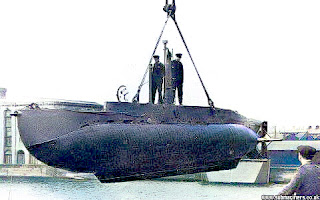
  Wehrmacht forces on the Greek island of Cephalonia began the massacre of Italian troops of the Acqui division. The Italians had briefly fought the Germans after taking a vote on what to do following their country's surrender. About 5,000 Italians would be killed out of hand. Similar slaughters took place elsewhere notably Kos and Corfu. Under the command of General Giraud about 2,000 French troops were landed on Corsica from French warships. In part this was motivated by fears that the local maquis might be exterminated after attacking German occupation forces.  In the event Hitler had decided to abandon both Corsica and Sardinia so the operation proceeded with only moderate casualties. Some of the Italian occupation forces fought against the Germans. This was the first allied landing on French soil and Corsica was the first French departement to be liberated. The operation was the last hurrah of Giraud's faltering campaign to lead the Free French. British mini-submarines (...

Eighty years ago the Italian campaign proper gets off to an inauspicious start

Image
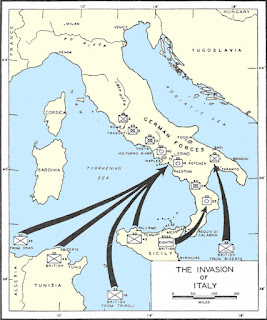
    The Allies staged the major landing aimed at capturing Naples in the first stage of conquering Italy. In operation Avalanche one US and one British corps landed at Salerno south of the city under the command of US general Mark Clark. This was the first time British forces were commanded by a US officer in a major operation. Clark was a favourite of General Eisenhower but he had only been a staff officer; this was his first battle command. The Germans were well prepared and staged two full scale counter attacks on the bridgehead which came close to pushing the Allies back into the sea. Faulty planning by Clark has been blamed. The British corps commander Richard McCreery did much to save the situation although 300 British replacement troops mutinied and refused to go to their new units because promises to return them to their original units were broken. Fire support from almost unopposed allied naval units provided critical assistance. The remaining Bitish forces under Mont...

Eighty years ago the allies dip a toe onto the toe of Italy

Image
  British and Canadian forces under General Montgomery landed in Calabria on the toe of Italy  just across the Straits of Messina from Sicily, the first allied forces to arrive on mainland Europe. It was a sad specimen of confused allied planning. Montgomery had objected to the plan as it would leave his forces with a long drive to the true battlefield in the north. The aim of the operation was to tie down German forces to smooth the planned major landing further north at Salerno.   The Germans did not oblige and Montgomery faced minimal opposition. Australian and US forces landed at Lae on north-east New Guinea, opening the reconquest of the island from the Japanese. The allies were beginning a major drive against the Japanese in the region after the long attritional battles on Guadalcanal and to ward off Japanese attacks against the south of the island. The attack featured a regiment of US paratroop, who seized an airfield inland from Lae in the first major drop in the ...

Eighty years ago this week Churchill puts his man in to run the war in India

Image
    One of the decisions taken at the Quebec summit meeting was announced: the appointment of the 45 year old Vice-Admiral Lord Louis Mountbatten as supreme commander for the newly created Allied South East Asian Command (SEAC). American acquiesence was inevitable. The US had few assets in the region, in practice India and Burma. His deputy was the American General 'Vinegar Joe' Stillwell but Stillwell's principal task was liaising with Chinese ruler Chiang-Kai-Shek and never behaved as Mountbatten's subordinate anyway. The official SEAC flag displayed only a Union Jack. SEAC was quite distinct from the Pacific theatre which was essentially a US show, albeit a battleground between the US Navy and General Douglas MaCarthur, who pursued entirely separate strategies. Mountbatten's was very much Churchill's personal appointment. He had never commanded anything larger than a destroyer in battle, but he had lived up to Churchill's expectations as head of Combined ...

Eighty years ago this week the Allies hold Germany on the back foot in the Bay of Biscay and Ukraine

Image
  The Quebec conference between Roosevelt and Churchill shaped allied strategy. They would seek the unconditional surrender of Italy and, in line with Churchill's wishes, agreed to extending the campaign in the Mediterranean to a full invasion of Italy. Churchill did though accept May 1 1944 as the date for Overlord, the cross-Channel invasion of France although he nursed hopes for an attack on Norway. No-one else on the allied side supported the Norway scheme although Hitler, whose grasp of psychology was better than his strategy, remained alert to the danger. The British conceded primacy in the development of nuclear weapons to the US, in practice conceding that they simply did not have the economic resources left to conduct serious activities of their own. The British Cabinet sent a formal message of thanks to RAF Coastal Command. This chiefly reflected the success of the Command's patrols against U-boats transitting through the Bay of Biscay to operate in the Atlantic which...

Eighty years ago, the US 8th Air Force showed how much it had yet to learn whilst RAF Bomber Command showed much it had learned

Image
  The US 8th Air Force launched its first serious raid on Germany. The targets were the Schweinfurt ball-bearings factories and the Regensburg aircraft plant, deep in southern Germany well beyond fighter escort range. Because of differences in weather conditions the original plan for simultaneous attacks was abandoned so the Luftwaffe was able to bring its full strength to bear on each formation in turn. The ex pectation that the B-17s would be able to defend themselves proved illusory and casualties were  severe. Of 376 bombers, 60 were shot down and the same number were badly damaged. The targets were hit badly but speedy repairs and the use of slack capacity still present in German industry meant comparatively little output was lost. The Americans suspended daylight raids.   600 RAF Bomber Command aircraft attacked the German research station  at Pe enemünde which had been identified as the centre for the development of rocket weapons to attack Britain and th...

Eighty years ago this week, probably the Allies best general blots his copy book

Image
    The British and US armies met in Sicily near the town of Bronte. According to Allied propaganda this trapped large numbers of Germans in the pocket between the armies but this was a fiction. The Germans had withdrawn to the port of Messina in good order without informing the Italians, still notionally their allies. From Messina they began to evacuate to the mainland. The Allied failure to prioritize cutting off this exit route from Sicily cost them the opportunity to elminate 60,000 Wehrmacht troops with heavy equipment. General Patton had demonstrated his competence and drive in the Sicily campaign which gave him a claim to be the Allies' best battlefield commander, but he proceeded to undermine his own standing. In two separate incidents he slapped soldiers hospitalised with shell-shock, accusing them of simple cowardice. These became public and Patton was forced to apologize. The episode could easily have ended the career of a lesser commander, but it almost certainly h...

Eighty years ago this week, the US 9th Air Force launches a brave, but futile and costly raid on Romania and the initiative on the Eastern Front swings to the Soviets

Image
  The US 9th Air Force launched Operation Tidal Wave from bases in Libya recently taken from the Italians. 177 B-24 Liberator bombers were despatched to attack the oil refineries around the oil fields at Ploesti in Romania, Germany's most important source of oil. It was to be at low level and involved a round trip of 2,000 miles. The Americans had launched a small raid on Ploesti over a year before and encountered minimal opposition. Expecting the same the attack was made in daylight, but it encountered stiff reistance fom both German and Romanian fighters. 53 bombers were destroyed and 55 severely damaged. Around 500 crew were lost, either killed, POW or interned in Turkey: the worst casualties suffered in a major operation. Oil production suffered only minimal interruption. The Red Army launched a major offensive aimed at Kharkiv (Or Kharkov as it was then usually known). The Soviets outnumbered the Germans by a large margin and were able to advance with little interference. It ...

Eighty years ago this week, RAF Bomber Command finally comes of age and the conquest of Palermo masks flaws in allied planning in Sicily

Image
  RAF Bomber command launched Operation Gomorrah under which the port city of Hamburg was to be bombed over several days. Almost everything was in favour of the attackers. Bomber Command now fielded a force of some 800 aircraft, mainly four-engined bombers, notably the highly effective Lancaster. H2S navigation radar had been fully introduced and the broad river Elbe leading from the sea to the city provided unmistakable images. After long top-level debate the use of Window had been authorized. Bundles of metal strips were dropped creating confusing images on the defenders' radar, which meant that fighter opposition was weak to negligible. Bomber casualties were low at some 3%. The weather was favourable both to the attackers and to the effect of the bombing; individual fires burned strongly enough to merge into a gigantic firestorm. After years of failure Bomber Command was finally able to put to the test the Trenchardian doctrine that bombing was able to win a war....

Eighty years ago, the Italians are softened up for attack and a Red Rat is removed

Image
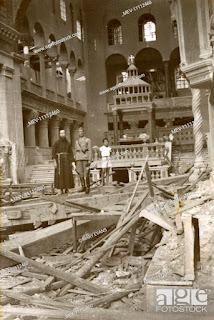
  Allied aircraft dopped over Italian cities a leaflet signed by Roosevelt and Churchill inviting Italians to  turn their backs on Mussolini and to abandon support for Nazi Germany, "The time has now come for you, the Italian people, to consult your own self-respect and your own interests, and your own desires for a restoration of national dignity, security, and peace. The time has come for you to decide whether Italians shall die for Mussolini and Hitler-or live for Italy and for civilization." More ominously the leaflet spoke of Italy's vulnerability to attack from the air. At a more practical level, Rome suffered Operation Crosspoint,  its first air raid. It supposedly targeted railway marshalling yards but hit civilian districts, killing killed 1,500 people and damaging the Basilica of San Lorenzo Fuori Le Mura . George VI's private secretary Sir Alex Hardinge was removed from office after seven years. He was deeply unpopular; socialite MP Chips Channon detest...

Eighty years ago this week the Allies invade Sicily in imperfect harmony and the Duke of Windsor dabbles in detective work

Image
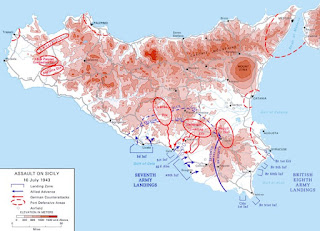
  The Allies launched operation Husky, the invasion of Sicily. It was the largest amphibious operation of the war so far and featured a large airborne component as well. It was split into a British landing in the East commanded by General Montgomery and an American landing in the West under General Patton. Both were under the command of the British General Alexander, but he did not use a tight rein and his two notional subordinates conducted largely separate campaigns. The attack made Hitler cancel another effort against the Kursk salient on the Eastern Front, ample proof of Germany's massive strategic overeach. Misled by Allied deception operations, the Germans reinforced Greece and not Italy. The Canadian mining millionaire Sir Harry Oakes was murdered on the Bahamas. His French son-in-law was swift ly charged with the crime but there were doubts over his guilt. Ill-advisedly, the governor of the territory, the Duke of Windsor, took personal charge of the investigation and impor...

Eighty years ago this week, Hitler rolls his last dice on the Eastern Front

Image
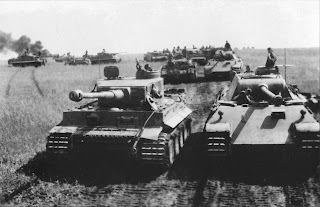
  The Germans launched Operation Zitadelle aimed at pinching out the Soviet salient at Kursk, beyond which the operation had no serious strategic purpose. Hitler had insisted on some form of offensive on the Eastern Front for reasons of prestige in the teeth of his generals' advice, notably Manstein's. They would have preferred to husband resources for counter-offensive action; with an Anglo-US incursion into continental Europe a growing certainty, German forces were spread ever thinner. But standing on the defensive would have admitted strategic defeat. Worse, the attack had been postponed repeatedly because of weather and for the introduction of the new Panther and Tiger tanks, which were supposed to reverse the superiority of Soviet types. The Germans got the worst of both worlds; their new types were brought into service still with many teeething problems and the Soviets had had time to prepare defensive positions. General Sikorski, the political and military leader of the...

Eighty years ago this week Britain sets the seal on its first major victory of the war

Image
  Britain set the seal on its first significant, unarguable triumph of the war with the issue of the Africa Star to those who had fought in North Africa for "a victory that will shine in history." Those who had fought elsewhere were not to be left out and they would receive what was then called, the 1939-43 Star, later the 1939-45 Star, a blanket decoration for all who had seen service. The Africa Star was the first medal of the war to reward a specific campaign. For the sixth day in succession the lead story in The Times was of a bombing attack, a good indication of quiet news elsewhere. Bomber command was still heavily commited to the Battle of the Ruhr but the last really big raid - on Wuppertal - was some weeks in the past. King George VI approved the final design of the "Sword of Stalingrad" which was to be presented  to the Soviet city in honour of its resistance while he was still visiting forces in the Mediterranean theatre. He chose one design from a number...

Eighty years ago this week, Churchill clears the decks in India

Image
  Churchill rejigged army high command responsibilities in India. He moved Wavell from the job of C-in-C to become the Viceroy in succession to Lord Linlithgow. Given Churchill's determination to preserve the raj, it is unlikely that he wanted Wavell to improve on Linlithgow's lacklustre showing in persuading Indian leaders to support the war effort actively. Churchill had never liked Wavell and the move took him even further from active military command. He was replaced as C-in-C by Auchinleck who had been unoccupied since being sacked from the Middle East six months before and refusing command in Persia. Auchinleck had never drawn Churchill's contempt in the same way as Wavell but his days as a fighting commmander were numbered. The job was merely administrative and organizational; control of the battle against Japan was reserved for other commanders and they were to be men more to Churchill's taste. George VI left Britain for the first time during the war to visit al...

Eighty years ago this week, the air battle for Europe takes shape

Image
  The allied Chiefs of Staff signed the Pointblank directive which set objectives for their combined bomber offensive. The principal goal was the reduction of German fighter strength necessary to invade Europe. The directive asserted that it would be better to damage a small number of "really essential industries" severely than damaging many a little. The project was essentially American; RAF Bomber command was given a large get-out clause as the plan "did not attempt to prescribe [its] major effort." Bert Harris was safe to pursue his strategy of winning the war by bombing German cities alone. The RAF did, though, make a major concession to a rational use of air power in the pending attack on mainland Europe. A "Tactical Air Force" was formed in Britain on the model of the organisation that AM Tedder had developed to support the surface operations of the other armed forces in the Mediteranean, where practical experience had demonstrated that the RAF's...