Posts

Showing posts from March, 2023

Eighty years ago the debate opens on the shape of the post-war world

Image
  Britain and the US began to muse publicly about what the world might look like once the war was over. Churchill had started the ball rolling with a high-profile speech later published under the title "A Four Years Plan for Britain." It addressed international affairs with the idea of "a world institution embodying....the United Nations" and some association of continental European countries, a Council of Europe. At that stage the United Nations was simply the informal name for the military alliance around the big three powers. Whatever came about would rest on agreement between Britain, the USA and the USSR. Americans went one bettter with the suggestion of China as a fourth major component in the alliance received an airing, in practice as a counterweight to Britain in Roosevelt's vision of a decolonized post-war world. The debate also opened as to what Germany's status should be, whether the German people would be allowed the opportunutiy to redeem itse...

Eighty years ago this week the Foreign Office's scissors hover over the old school tie

Image
  A White Paper on reforming the Foreign Office was published and was well received. The ambition was to move the organization on from its status as an aloof domain of the upper classes. Predictably it was light on detail, beyond proposing a merger of diplomatic and commercial branches; including the consular service was deemed to be a step too far at that stage. The goal was set of opening the service to all men of ability (the question of female entry was held over). The White Paper was embodied into concrete reforms in 1947 and in 1966 Britain appointed an ambassador who had gone to a state school, had no university education and entered as a consular officer. General Montgomery's Eight Army launched Operation Pugilist  a full-scale assalt on the Axis Mareth line in Tunisia. It had been built by France as North African counter-part to the Maginot line in the 1930s. The frontal assault was beaten back with heavy losses but the LRDG had identified a route to outflank the line...

Eighty years ago Germany shows that it is still a dangerous enemy

Image
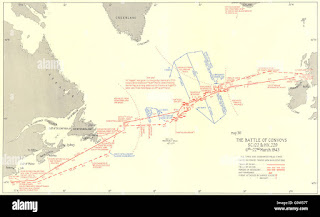
  Germany had been pushed firmly onto the back foot but it was anything but defeated as two striking defeats for the allies demonstrated. The allies suffered their worst convoy disaster of the war. The build-up of US forces in the European theatre had swelled the number of sailings, and hence of targets.  A fast convoy (HX229) and a slow one (SC122) overlapped in mid Atlantic presenting a group of 100 merchant ships to the U-boats. Evasive routing failed and the Germans were able to concentrate 40 U-boats from three different wolf packs against the target. 21 merchantmen with a total of 141,000 tons were sunk for the loss of a single U-boat although half-a-dozen more were damaged. It was the worst moment in a very bad month for allied shippping in which a total of 108 ships were sunk. The British Naval Staff later judged that the Germans "came very near to disrupting communications between the New World and the Old." The Red Army paid a penalty for over-confidence created by ...

Eighty years ago this week the RAF bombing offensive against Germany moves up a gear

Image
  Air Marshal 'Bert' Harris launched RAF Bomber Command into what came to be called the Battle of the Ruhr with a 442 plane raid on Essen. Harris had distorted the directive that he had been issued after the Casablanca conference into a license to prioritise attacking German morale, which he believed would win the war on its own. Bomber Command now had sufficient heavy bombers of the Lancaster class and, perhaps even more important, had adopted radio navigation aids to have a meaningful prospect of launching devastating attacks on Germany. Before the war the Air Staff had deluded itself that it would be able to attack the Ruhr (which it saw as a similarly vulnerable, high value target to London) and win the war with the resources it then had at its disposal. Essen with the Krupp weapons factories was a difficult target, well-defended and usually cloaked in industrial haze. Thanks to the Oboe radio navigation system one third of the aircraft bombed within three miles of the aimi...

Eighty years ago Norwegian special forces cripple Germany's nuclear programme

Image
      A team of Norwegians trained by Britain's SOE parachuted back into their country to attack the Norsk Hydro hydro-electric plant at Vermork, which was by far the largest European source of deuterium rich heavy water, inititally a by-product of the plant's core operation. Heavy water was the Germans' preferred moderator in the process of making plutonium needed for nuclear power and weapons. They had rejected graphite, which was in reality the better option. The Germans had reinforced the defences of Vermork after the complete failure of a British attack on the plant by glider-borne infantry, but the Norweigan operation was was a complete success.  The stock of heavy water was destroyed and vital equipment wrecked. Amazingly all the attackers survived. Perhaps curiously, the Germans did not draw the obvious conclusion from the resources the Allies devoted to depriving them of heavy water and recognise that nuclear weapons were a mjaor threat. The Japane...