Eighty years ago this week the rehabilitation of Germany begins with "The Speech of Hope"
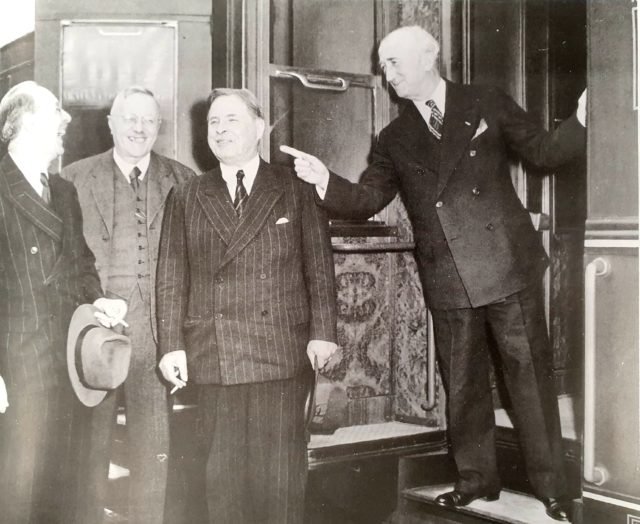
James Byrnes, the US Secretary of State, gave a speech in Stuttgart under the title "Restatement of Policy on Germany." It was delivered to a large audience including the three ministers president of the states in the US zone, who had greeted Byrnes when he had arrived train in a highly symbolic photocall. In particular Byrnes declared that Germany should not become the satellite of any power or a dictatorship. He stated that the economic conditions ruling in the country divided into four zones of occupation made it impossible to maintain a peace-time economy and that free exchange between the zones was needed. He looked forward to a future when the government of Germany would be returned to the German people. In practice he was rejecting the Soviet policy of treating its zone of occupation merely as a resource to be exploited purely for Soviet benefit. Byrnes claimed the authority of the Potsdam Agreement for his vision, but in practice he was proposing the creation of a prosperous unified nation as opposed to the Soviet model. Byrnes was heavily influenced in making the speech by General Lucius Clay, the US military governor of the zone. It was christened "The Speech of Hope" and is regarded as one of the foundation stones of what became the Federal Republic of Germany.
The Ukrainian delegation to the UN served as Moscow's mouthpiece in an attack on the supposed threat to peace in the Balkans posed by Greece under de facto British control. Elections in Greece and the referendum to retain the monarchy had gone against the communists. Given Greece's internal divisions and poverty it could barely be said to be capable of conducting a foreign policy. The Ukrainian complaint was vehemently rejected by Britain, the US, Australia and the Netherlands.
Britain was suffering from an acute shortage of housing affecting mostly returned servicemen and their families which triggered a largely spontaneous wave of large scale squatting. Probably with memories in mind of similar problems which had followed the end of the First World War the occupiers received widespread support, notably from Clemmie Churchill, the former prime minister's wife who decried using the word "squatters" as pejorative. To begin with this had involved military camps, empty and redundant after the war. The Communist Party organised the high profile occupation of 1,500 properties in upmarket areas of London in particular Kensington under the banner "the Great Sunday Squat". These included flats requisitioned for government departments during the war which were about to be returned to their owners.


Comments
Post a Comment