Posts

Government Struggles to Convince Anyone that Rearmament is Being Taken Seriously

Image
Tuesday 10 th November 1936 The Debate on the Address – in effect the first Parliamentary debate of the new session – developed into a wide ranging debate on defence and rearmament issues. It was conducted in an objective and calm style, but, perhaps perversely, the absence of passion laid bare the flaws in the government’s programme and the political and bureaucratic cross-currents that hampered the work. Sir Thomas Inskip, the minister for the coordination of defence, was competent, honest and a dedicated public servant, but he had neither the official remit, character nor ambition either to blast through road-blocks or to give the House and the public the impression that the government really cared. The great rallying call for enthusiastic rearmers was the need for a Ministry of Supply, successor to Lloyd George’s Ministry of Munitions of the First World War, a solid sign that national energies were being channeled into preparing for war. But there lurked in the bac...

The Fuehrer Clarifies German Ethnic Status

Image
Monday 9th November 1936 Hitler led the observance of one of the holiest days in the Nazi calendar, the anniversary of the failed Beer Hall Putsch in 1923. In keeping with tradition, the events began at the Bürgerbräukeller from which the attempted coup had been launched with a speech by the Führer. He told his audience that he had never striven for the love of foreign countries only the respect which is never denied to a brave nation. The world now knew that Germany could not be treated as though a nation of Zulu Kaffirs. He then led a procession of 3,000 “old fighters” through an alley of 250 pylons topped with bowls of flaming pitch to the Feldherrnhalle. Each pylon commemorated a Nazi supposedly killed in the struggle against the Reds. The most solemn moments were devoted to the sixteen Nazi fatalities of the Putsch itself with a sixteen gun salute.

The Siege of Madrid Adds Another Phrase to the Lexicon

Image
Sunday 8th November 1936 The four conventional columns of the Spanish Nationalist army launched what was supposed to be the final stage of their offensive on Madrid. The attack was on a narrow front through the open park of the Casa de Campo. The Republicans had got wind of the plan and concentrated troops to defeat it. The situation was so precarious, though, that the government fled the city to Valencia. General Miaja nearly wept with rage, when he was put in command of defenders, seemingly a doomed and sacrificial mission. The Republican defenders were exhorted to greater efforts by a simple slogan, originally coined by the Republican and Communist propagandist Dolores Ibárrui Gómez “La Pasionara, "¡No passarán!" , they will not pass, another phrase that has gone into posterity. The siege lasted two and a half years, almost the remainder of the war.

Behind the Scenes of the Abdication Crisis

Image
The crisis over Edward VIII had been bubbling below the surface since the start of his reign in January. As his behaviour with Mrs. Simpson became less and less discreet, concern grew at the highest level of government. When the new broke that Mrs. Simpson was seeking a divorce from her husband in mid-October, the horrible possibility opened itself that the King might want to marry her and make her his Queen.  The Prime Minister Stanley Baldwin came under pressure from government hardliners to act, but his first informal conversation with the King proved entirely inconclusive. When Mrs. Simpson failed to deliver on a vague agreement to leave the country after the divorce hearing, tension began to overflow. The full, behind the scenes story of what happened next and the factors that drove the action, are told in my book The King Who Had To Go just published by Biteback at £25 https://www.bitebackpublishing.com/books/the-king-who-had-to-go

The Spanish Civil War Enriches the Vocabulary

Image
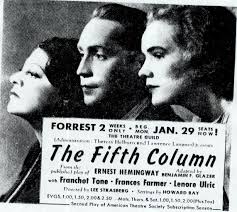
Saturday 7 th November 1936 The latest phase of the Spanish Civil War enriched the vocabulary in two ways. At a more parochial level the insurgents had branded themselves as the Nationalists, which has tended to stick in the accounts of the conflict, more because all other terms proved unattractive than because of its accuracy. The other was also an exercise in propaganda – transparently aimed at unsettling the other side –but it created a term that endures to this day. The insurgent army was advancing on Republican-held Madrid in four columns and one of their Generals Emilio Mola boasted that there was a “fifth column” of supporters already in the city. It was mythical, but friendly media reported attacks by Falangists, Guardia Civil and Shock Guards as fact. When Ernest Hemingway used the phrase as the title of his only played, written whilst he was in the besieged city, its future was guaranteed.

Franco-Lookalike Grabs Power in Iraq

Image
Friday 6 th November 1936 The Minister for foreign Affairs of the new Iraqi government in Baghad set out the circumstances of the departure from power of its predecessor under General Yasin al Hashimi. Hashimi had come to power eighteen months before with a great reputation and great expectations that he would succeed as national leader. He had not. There had been approximately five tribal risings during his time in office and none of the country’s deep-seated problems had been properly addressed. This had all prompted the professional head of the army, Bakr Sidqi, to stage a coup, possibly the first of the many classic military coups that in the modern Arab world. Sidqi bore a faint, but unmistakable, physical resemblance to Franco. Taking advantage of Hashimi’s absence abroad, Sidqi brought almost all the senior offices out against him, began a march on Baghdad and, in another premiere, dropped leaflets on the capital from aeroplanes, demanding the reinstallation of ...

Appeasement Before it Became the A...... Word

Image
Thursday 5 th November 1936 The King’s speech two days before had promised that the government would pursue its policy of the “appeasement “ of Europe. The word had yet to acquire its pejorative connotations and meant no more than the bringing of peace to. So much was clear from the speech by Anthony Eden in the debate on foreign policy. It was a thoroughly pacific performance. The main goal seemed to be to restore faith in the League of Nations after a “single failure”. Italy, the author of this failure came in for gentle treatment with an assurance that he recognized that the Mediterranean was “vital” to Italy as well. The only hint of firmness was to reject German claims that they had been financially oppressed. The commitment to rearmament crept in as an afterthought in terms that made it painfully clear that the programme was merely to remedy gross weakness.