Posts

Eighty years ago, the German invaders head for the symbolic prize of Leningrad

Image
  It was unclear whether the German armies were going to push on to Moscow. No decision had been firmly taken and there was a vigorous debate as to whether German armies should concentrate on the symbolic conquest of the Soviet capital or to concentrate on more tangible objectives such as the oil fields in the south. The partisans of a symbolic move against an iconic Soviet city did, though, hold sway in the North. With Hitler’s enthusiastic backing it was decided to make an all-out attempt to take Leningrad, cradle of the communist revolution and the monument to its most revered leader. The city of Novgorod was captured which all but set the seal on the encirclement of Leningrad. The scene was set for one of the great set-piece engagements of the eastern front. Anglo-Soviet cooperation bore immediate practical fruit. Neutral Iran occupied a strategic location between the British dominated Middle East and the Soviet Union. German business interests had long been well-established ...
Eighty years ago the desert war finds its soundtrack

Image
  The Germans continued their seemingly unstoppable advance into the Soviet Union.  The important naval base of Nikolaev on the Black Sea fell without a battle. The dockyard installations were mainly destroyed but large stocks of material were captured some partly completed warships escaped to ports on the eastern, Georgian seaboard of the Black Sea, but facilities for completeing them and maintaining other ships were limited and primitive. The Germans were to enjoy the advantage at sea for some months to come. Britain and the US pledged full economic assistance to the Soviet Union, which was treated as a full ally in the struggle against Nazi Germany. President Roosevelt convinced himself that the Soviet regime  was essentially benign and deserving of every support possible. Stalin graciously accepted what the western allies offered him unconditionally. A three-power conference in Moscow to decide on ways and means was agreed on. The German troops in North Africa rather ...

Eighty years, Roosevelt and Churchill hold their first summit meeting

Image
  The true reason for President Roosevelt’s mysterious “holiday” was revealed. He was holding a summit meeting with Winston Churchill. They had met once before during the First World War but Churchill had been a senior national politician and Roosevelt very junior in the administration; Churchill had long   forgotten the encounter. They had corresponded extensively since Churchill’s accession to power but this would be the moment for them to establish a working relationship. The venue was carefully chosen:   Placentia Bay was in Newfoundland and thus British territory but the US was building an airbase there as part of the destroyers for bases deal of the previous year. Churchill arrived on the battleship HMS Prince of Wales which had been involved in the hunt for Bismarck a few weeks before. In practical terms the meeting was a disappointment for the British. Roosevelt did not promise to enter the war as Churchill hoped he would. The joint statement of goals the le...

Eighty year ago a rare German domestic critic of the regime survives and forces the Nazi programme of euthanasia undergound

Image
  An aristocratic German Catholic bishop, Clemens von Galen, delivered a third   sermon, decrying Nazi tyranny. The first two had attacked the Nazis in general terms for their brutality and oppression, but this one pointed clearly to a specific atrocity. Galen spoke of the mentally ill people who had been removed from their homes, with their families later being informed that they had died. He accused the German state of murder. This referred to the T4 euthanasia programme under which people – predominantly German citizens – deemed unfit to live were murdered. It was precursor to the Holocaust. The sermon was widely circulated as an unofficial pamphlet. The propaganda minister Goebbels resisted calls to have Galen punished for fear of alienating Germany’s Catholics. Murder of the disabled continued albeit far more circumspectly than before. President Roosevelt took two further steps towards bringing the US into the war. The Lease Lend programme of sending arms supplies pra...

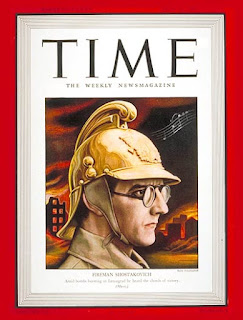
Eighty years ago, the Soviets promote an image of heroism and culture

Image
  Churchill’s critics continued their campaign of largely ineffectual harassment after they failed to draw blood over the reconstruction of the Ministry of Information, arguably the government’s point of greatest vulnerability. Now the ostensible goal   of the insurgents was to secure the establishment of a Ministry of Supply. In practice their target was Lord Beaverbrook, recently elevated to the Ministry of Supply, and the most conspicuous specimen of Churchill cronyism in the Cabinet; insofar as a Ministry of Production would have served any purpose, it would have largely duplicated the work of the Ministry of Supply. The extreme left hankered after even greater state control of the economy but the true motive was discontent at the lack of opposition to Churchill’s monolithic government. With a contemptuous inquiry as to what the “superman” Minister of Production was supposed to achieved, Churchill easily rode out the agitation. Having paid the penalty in Syria and the Le...

Eighty years ago, at its darkest hour British propaganda launches its best campaign

Image
  The hugely successful British comic author P.   G. Wodehouse, creator of idiotic socialite Bertie Wooster and his manservant Jeeves, made a fateful mistake. He had been interned by the Germans when his home in Le Touquet was overrun in 1940 but had just been released when eh reached the age of 60. Naïvely he accepted a German request to make a series of radio broadcasts. These were light-hearted, humorous and in no way propaganda, but the mere fact he was willing to speak on German radio appeared deeply suspect. He was abused as being practically a traitor, most venomously on the BBC by the Daily Mirror journalist William Connor (“Cassandra”). Connor’s attack was so unbalanced that it provoked severe criticism of the BBC. The “Cassandra” affair created an elegant opportunity to shift MP Harold Nicolson from the Ministry of Information to the BBC as a governor without consulting the existing governors. Nicolson was disappointed at what he recognised as a demotion but he was...

Eighty years ago, the guns fall silent, but only in a miserable conflict between former allies and then only for a while

Image
  The German invasion of the USSR helped save the career of the British ambassador, Sir Stafford Cripps, an extreme left-wing Labour politician, who had been sent to Moscow in the hope that that his immense indulgence towards Stalin would count in Britain’s favour. It had not; the Soviets had been more suspicious of Cripps's parade of pro-Soviet sentiments than they would have been a frankly capitalist envoy. Cripps’s waywardness and general neglect of British interests as distinct from apologising for the cause of Stalinism had led to his being recalled to London by the Foreign Office just before Barabarossa with a   permanent return to the UK in disgrace as a distinct possibility. As it was, he now found himself signing an Anglo-Soviet treaty pledging each country to wage war against Nazi Germany and not to make a separate peace. The Soviet signatory was foreign minister Molotov, albeit under the watchful eye of Stalin himself. It was one of the corner-stones of Cripps’s s...