Posts

Eighty years ago, blackmail battles oratory inside the British government

Image
    Lord Beaverbrook’s campaign to elbow himself a larger share of power in government, and, perhaps to position himself to displace Churchill, found its way into public notice, albeit in well-disguised form. He had intensified his drive to promote giving maximum support to the Soviet Union, which served as a platform to attract support both inside government and with the public.   Stories appeared pointing to the strain on his health – he was known to suffer from badly from asthma – brought on by the intensity of his working arrangements. What was hidden was the fact that as well as periodic threats of resignation on points of principle he bombarded Churchill with threats of resignation on the grounds of health. It is not known who lay behind this move to call Beaverbrook’s bluff. Churchill’s standing was always greater with the public than inside government. His greatest strength was his oratory which bound the nation to the war effort; the staunchest Chamberlainite a...

Eighty years ago a Soviet super-spy is arrested in Tokyo and France enters a cycle of random killing and reprisal

Image
  The career of one of the most successful spies ever came to an end when Japan's military security police, the Kempetai, arrested Richard Sorge, a German journalist and long term Soviet agent. As well as a network of Japanese agents, Sorge had a close relationship with the German ambassador to Tokyo Eugen von Ott and had access to all his communciations with Berlin. Von Ott tolerated Sorge's affair with his wife, one of his very many mistresses. Sorge had accurately warned his controllers of the pending German invasion and, perhaps more important, that Japan had decided against attacking the Soviet Union, which freed the Red Army to concentrate on fighting the Germans. Stalin discounted Sorge's warnings of Barbarossa like all the others and preferred to keep his deluded trust in Hitler, but may have paid attention to the information on Japan's intentions. Sorge's one-time pad coded messages to Moscow were never broken but their sheer volume gave almost unmistakeabl...

Eighty years ago Japan chooses war

Image
  The army won the latest and crucial round in the struggle for Japanese policy. The navy faction which supported the prime minister Prince Konoe and wished to avoid war with the US was defeated.   Konoe’s overtures to the US had failed to yield worthwhile results; President Roosevelt stuck to his hard line. German success in the East further strengthened the army’s hand. The Emperor swung behind the army. Konoe resigned, clearing the way for General Tojo to replace him. It became a matter of time for Japan to go to war. The German attack towards Moscow progressed, seemingly with remorseless success, but there were clear signs of military over-reach. Another two huge groups of Soviet troops were surrounded in the Vyazma and Bryansk pockets. Ultimately perhaps 0.5m would be taken prisoner, but in the meantime they fought on. This tied down over twenty German divisions in a battle of attrition, which weakened the thrust towards the Soviet capital. The loathsome farce of th...

Eighty years ago Hitler breaks cover into hubris

Image
  Hitler made his first speech since Operation Barbarossa was launched. It was perhaps the high-point of the Third Reich’s triumphalism. He was in confident mood and portrayed the thrust towards Moscow that had been launched a few days before as a decisive step in the defeat of the Soviet Union. He boasted of 2.5m prisoners taken. Curiously he spent more time attacking Churchill, whom he blamed for the war, than Stalin. He did accuse the Soviets of planning an attack but the best he could come up with to present Germany's policy towards the Soviet Union in a favourable light was to assert that no criticism of the Soviet Union had been allowed to appear in German media. He claimed that Germany was strong enough to meet any enemies, a faint warning shot across the bows of the US. Stalin at a stroke reversed decades of Soviet hostility to religion and declared that there would henceforward be full freedom of worship. In part this aimed a mobilizing the Orthodox church, which had n...

Eighty years ago the SS wins the battle for control in Prague

Image
  German occupied Czechoslovakia had become a battleground between the terrorists of the SS and the conservatives. The latter were represented by Konstantin von Neurath, an old style diplomat who had been replaced as foreign minister by Ribbentrop in 1938, and had been installed as Reich protector in Prague in a cynical atttempt to persuade world opinion that Czechoslovakia would be ruled in a decent fashion. Von Neurath did not endorse Nazi plans to obliterate Czech culture and conducted a soft-touch policy through Czech collaborationists. To discredit him the SS staged attacks, supposedly the work of the Czech underground. With the war against the Soviet Union under way, security in Czechoslovakia had assumed a new dimension. When the SS forced the issue, Hitler took their side and sent von Neurath "on leave", installing as his effective replacement Reinhard Heydrich, the master secret policeman, architect of the Holocaust and one of the most effective and fightening figure...

Eighty years ago a massive solar flare lights the sky

Image
  The British government launched an initiative to bring home to the public and to the Soviets its commitment to supporting the Soviet Union in its war with Nazi Germany. “Tanks for Russia ” was declared with the conceit that every armoured vehicle made in Britain during the seven days would be shipped to its new ally. The campaign was probably more aimed at the home front than towards Moscow. Much of the surrounding propaganda focused on issues of productivity; British workers were being exhorted to greater efforts supposedly to sustain a socialist state and implicitly asked to suspend the all-too-capitalist approach to wage negotiations that characterised wartime labour relations. It was an early step in the heroification of the Soviet people that helped conceal from the British public the true nature of the regime there. If the drive even registered on Stalin is doubtful; his ambassador in London Ivan Maisky gave no hint of gratitude and simply sated that the Red Army would kno...

Eighty years ago Colonel Lindbergh's mask slips

Image
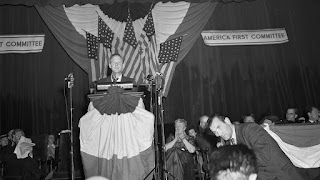
    After months of being the most effective voice of isolationism and the leading figure in the America First movement against US involvement in the war, Colonel Lindbergh hero of the first solo flight across the Atlantic, let the mask slip to reveal publicly the hateful sub-text of his appeal. In a speech at Des Moines that was broadcast on the radio he denounced the “war agitators”: “three important groups have been pressing this country toward war: the British, the Jewish, the Roosevelt administration.” Some of his claims could have come from the mouth of Goebbels: the Jews’, “greatest danger to this country lies in their large ownership and influence in our motion pictures, our press, our radio and our government.” He claimed to admire both the British and Jewish races, but made it plain that he did not consider Jews to be American. He issued barely veiled threats, “Instead of agitating for war, the Jewish groups in this country should be opposing it in every possible way...