Posts

Eighty years ago the British take an expensive lesson in how to conduct an assault landing
Image
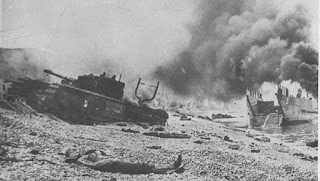
  In a year of almost unrelieved military failures the British had been able to take comfort from a series of amphibious attacks on German-held France and the growing effectiveness of the bomber offensive against Germany. They now proceeded to over-reach themselves with their most ambitious amphibious raid by far. With the memory of Stalin's abuse to Churchill of British resolution in Moscow a recent memory, they finally mounted a much postponed brigade strength attack on the port of Dieppe devised by Combined Operations . It fell well short of the 'Second Front' desired by Stalin, but should have demonstrated that the British were capable of a major cross-Channel attack. Operation Jubilee was a dismal failure and achieved almost none of its objectives. A sea-wall familiar to generations of travellers, prevented British tanks from joining the battle in the town. The attackers lost more than half of the men landed, 3,500 as casualties and 2,000 as POWs. Part of the plan had...
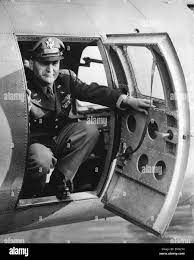
Eighty years US B-17s bomb France in a militarily worthless propaganda operation

Image
  The US air force conducted its first heavy bomber  raid on occupied Europe when twelve B-17s escorted by fifty or so RAF Spitfires attacked the large railway marshalling yards in Rouen. The purpose of the mssion was propagandistic and to put down a marker in inter-allied  squabbles on strategy. An article by a well-placed British journalist, Peter Masefield who was soon to become a senior official at the Ministry of Aircraft Production, probably influenced by the RAF Air Staff had questioned severely the value of the daylight raids that the Americans planned along with the combat value of their aircraft. Masefield mused that Americans might soon be flying British - and implicitly more effective Lancasters against Germany. The RAF had not been impressed by the batch of B-17s that it had tried out. Damage to the target was minimal and there were two hundred French civilian casualties. The B-17s suffered no casulaties, but there was no mention of the large fighter escort i...

Eighty years ago the scene is set for decisive struggles in the Pacific, Russia, the desert and over the future of India

Image
  US forces seized an airfield newly constructed by the Japanese at the southwesterly limit of their expansion. It would have helped them dominate the Solomon Islands which lay astride access from the East to New Guinea which was being bitterly fought over. It was on a hitherto almost unknown island called Guadalcanal. The allied naval forces covering the landing almost immediately suffered a severe defeat in a night engagement, called the Battle of Savo Island, but the US Marines held on. More important, the US could afford to lose ships, whilst the Japanese could not. Savo Island was only the first of the many fights that gave the patch of the sea the nickname "Ironbottom Sound" from the number of ships that would be sunk there. After a series of set-piece naval fights, the Pacific War now featured a ferocious battle of sea, land and air attrition.   German forces too a set a new south-easterly limit to the pentration of the USSR when they reached the city of Stalingrad whi...

Eighty years ago relics of the Chamberlainite régime receive tardy burials

Image
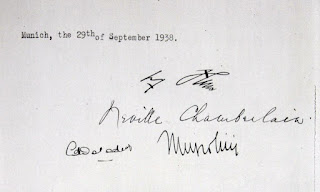
In a quaint nod towards a remote past and its customs, combined with an enthusiasm for selling a bear's skin long before it had been killed, Anthony Eden, the Foreign Secretary, announced formally that the Munich Treaty of 1938, by which the Sudetenland had been transferred to Germany from Czechoslovakia, would not be taken into account when a settlement was reached for Czechoslovakia's borders after the war. He explained this by saying that the Germans had destroyed the agreement; this rather begged the question of why the treaty had not been repudiated in March 1939 when Hitler flagrantly ignored its provisions by seizing the remainder of the country. Neville Chamberlain, then still prime minister, was still bent on appeasing Germany at the time and would have fought shy of so bold a denunciation of Germany. Repudiating the treaty would also have repudiated Chamberlain's beloved side-deal with Hitler at Munich, the Anglo-German Declaration better known as "Peace for ...

Eighty years ago Bert Harris diversifies into propaganda

Image
  In the wake of a heavy RAF raid on Hamburg the head of Bomber Command  Bert Harris diversified into propaganda. Speaking on the BBC he promised the German people unremitting bombing but invited them to prevent this by ridding themselves of the Führer. He pointed to the industrial resources of the US  and warned that they too  would be deployed in his campaign; the first B-17s had just arrived in Britain.  In the event the Americans declined to join whole heartedly in Harris's programme of bombing cities and the Germans declined to remove Hitler. When the broadcast was questioned in Parliament, the government stood by Harris albeit without explicitly  endorsing his statements. The Soviet forces west of the Don river were defeated in the battle of Voronezh. On the face of it this was yet another defeat for the Red Army but the fighting was hard with heavy German casualties and the German advance towards the Volga and the key city of Stalingrad was delayed f...

Eighty years ago the Vichy authorities do their bit for the Final Solution

Image
  Vichy collaboration with the Germans reached a new low point with a mass round-up of some 13,000 Jews in the Paris region. They were divided roughly equally between men, women and children. The operation was launched on German orders but executed entirely by the French authorities so as to preserve the fiction of autonomy. The victims were held at the former cycling arena, the Velodrome 'd'Hiver, and the crime is known as the 'Rafle du Vel' d'Hiv'. From there they were taken to concentration camps including Pithiviers and Drancy and thence to camps deeper in the Reich. Almost none returned alive. The chief architect of the operation, civil servant Rene Bosquet, was convicted in 1949 on a minor charge but almost instantly rehabilitated for supposed help to the resistance and went on to a successful career in politics until his guilt became too obvious to ignore. Air Chief Marshal Sir Hugh Dowding retired from the RAF at the standard retirement age of sixty. Aft...

Eighty years ago Allied sailors pay the price of supplying Stalin

Image
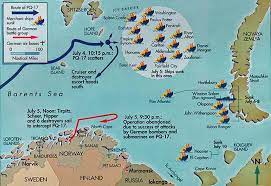
    Britain suffered one of its worst maritime defeats of the war when convoy PQ17 carrying supplies to the Soviet Union suffered huge losses at the hands of German aircraft and U Boats: 24 out of 35 merchant ships were sunk. The disaster occurred because of a misjudgement of intelligence and German intentions which created a firm belief that the battleship Tirpitz would sortie and attack the convoy. This led to the Admiralty sending orders for the covering force of cruisers to be withdrawn and then for the convoy to scatter. The orders came directly from Dudley Pound, the First Sea Lord, an old tired and desperately ill man.  with almost no night at the high latitudes the German forces had little difficulty picking off the isolated merchantmen.  Tirpitz never made her sortie. Stalin believed that the British were lying over the scale of losses to excuse sending fewer supplies than they claimed; only recently has any kind of monument been erected to the effort of br...