Posts

Royal Society Put Straight On The Panda Question

Image
Tuesday 30th June 1936 One of Britain's leading zoologists, Captain Guy Dollman of the Natural History Museum addressed the Royal Society.  He was an authority on the smaller mammals and gave his name to Dollman's tree mouse as well as helping to classify almost countless different types of shrew, but that night he was there to explain to members the true facts about both types of pandas. Above all, we wanted to remove any misapprehension that either was a kind of bear although he admitted that the giant panda was very bear-like and 99 people out of 100 would think it was one. Its teeth, face and colour markings made it clear that it was a quite different species. The colour pattern was the factor that made it most clear that the giant panda and the panda (today usually called red panda) had a common descent. For all his scientific rigour, Dollman was fully alert to the animals' visual appeal. The author makes no apology for featuring a photo of red pandas f...

Sir John Reith's BBC Harvests Reward For Good Behaviour

Image
Monday 29th June 1936 The government finally announced what it actually intended to do with the BBC on the basis of the Ullswater report which had been been grinding its way through the political process since 1935. The answer was rather little and what little was to be done was favourable to the BBC. Sir John Reith was being rewarded for good behaviour in the stewardship of what was, to a large extent, his creation. The term of its charter was extended by ten years and its share of the license fee pushed up to 75% with the possibility of more if it needed more money for Empire and television broadcasting. the number of governors was increased to seven with a one-third rise in their pay to £1,000 per year. Quangocracy is not a recent development.  Reith won a partial victory in his drive to exterminate the  hated private sector relay exchanges. Their licenses were extended for three years, but the Post Office was to begin experimental work to replace or absorb them....

Strain Tells on Prime Minister Baldwin

Image
Sunday 28th June 1936 The strains of the previous few months were beginning to tell on Prime Minister, Stanley Baldwin. Under a facade of bluff insouciance, he agonized over decisions. His camouflage was so successful that many of his colleagues thought that it was mere idleness that made him defer decisions, and not an acute awareness of the damage that a wrong decision could cause. On top of the Abyssinia and Rhineland crises, he had had to cope with the Budget leaks affair. In the usual way, he had gone to his official country retreat, Chequers, for the week-end, but late in the evening there came a surprise statement that he would now remain their for "a few days" of rest. In reality he was close to a nervous breakdown. The Home Secretary would handle his Parliamentary questions and the Lord Privy Seal would chair the Cabinet.

Riviera Laid Low By Hotel Workers' Strike

Image
Saturday 27th June 1936 A wave of strikes broke out at the hotels on the French Riviera. It came on top of strikes by transport workers and guests were soon left without any service at all. It was amongst the last waves of industrial unrest, ushered in by change of government to the Left wing Front Populaire . It was all the more worrying, as the Riviera was hardly an established hot-bed of socialist agitation. It brought home to the many British visitors, actual and potential, to such a beloved resort area just how unstable the country had become. Amongst the British people planning to holiday there that summer was none other than the King himself. It was not a prospect that appealed to the Foreign Office.

Sinister Opponent For Roosevelt

Image
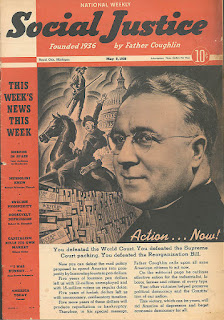
Friday 26th June 1936 The Democratic Party Congress in Philadelphia nominated President Roosevelt as its candidate for the the presidential election in November. He was the only contender. His selection had been a foregone conclusion for months, but there was still enormous enthusiasm at the prospect. There were 110,000 to listen to his acceptance speech. Few doubted either that he would beat the Republican Candidate, Governor Alf Landon, in the election itself. Landon was a lacklustre campaigner. Apart from his eventual defeat by Roosevelt, he is little remembered although he did live to the age of 100. His weakness attracted a third party to enter the contest, the Union party, led by North Dakota Congressman William Lemke, who announced his a rigorously protectionist platform on the same day. Lemke was backed by Father Charles Coughlin, the virulently anti-semitic "radio priest."

Storks Return To Britain

Image
Thursday 25th June 1936 In an attempt to reintroduce storks to Britain Germany presented 23 young birds, which arrived by Lufthansa at Croydon aerodrome. They were welcomed with a tasty meal of rabbits and fish. This followed on from a largely unsuccessful attempt to place stork eggs in herons' nests in the hope that they would be incubated. The last time that storks had bred in the wild in the UK was in 1416. The letter covering the gift from Dr. Schuetz, of the bird care organisation of East Prussia, made a point of saying how reluctant the local peasants had been to lose the storks and requested that they be kept in touch with the progress of the birds which had been ringed for tracing purposes. Dr. Schuetz assured his correspondent that letters with news might be written in English as there was someone in each village who could translate.

Plea For British Solidarity With France

Image
Wednesday 24th June 1936 Duff Cooper, the war minister, made a speech at the Cercle Interallie club in Paris that once again showed him willing to take a rather different line on Britain's Continental policy  than a good number of his colleagues, notably Neville Chamberlain. The Union Interallie had been founded in 1917 when the USA entered the war against Germany and was thus charged with symbolism. He said that the friendship between between France and Britain was not a matter of sentiment, but one of life and death. It was clearly a call for solidarity against the challenge of Nazi Germany and, to a lesser extent, Fascist Italy. Duff Cooper spoke in fluent French and his speech was praised by Camille Chautemps, the Minister of State replying on behalf of the French government. He remarked that he and the other listeners "could often understand between the lines" in a clear sign that the diplomatic significance of what Duff Cooper said had been fully apprecia...