Posts

Tibet Has a New Dalai Lama

Image
Sunday 31 st August 1936 The new and still today current Dalai Lama was identified in Tibet. His predecessor had died in December 1933 and according to Tibetan belief his spirit had transferred to a child born at the exact moment of his death. Given the size of Tibet it had taken some time to collect all the possible children and examine them for the bodily marks that proved his status. The return to Tibet of the Tashi Lama, second in the hierarchy to the Dalai Lama, from China, where he had been in exile since 1925 following disagreements with the late Dalai Lama, had added further complexity. The Tashi Lama was suspected to pro-Chinese inclinations. For the time being the new, infant Dalai Lama was being kept in a place of secrecy.

Moscow Leans on Oslo to Expel Trotsky

Image
Saturday 30 th August 1936 One of the chief motivations for the recent show trial in Moscow became clear when the Soviet government formally sought the expulsion of Leon Trotsky from Norway, where he had been in exile since the previous year following his expulsion from France. It repeated the accusations made in court, notably that Trotsky had plotted the murder of Stalin and the other Soviet leaders from the safety of Norway. The note stopped short of demanding Trotsky’s extradition to the Soviet Union; even Stalin’s Russia had a sense of what was plausible and what was implausible. The Norwegian government was at best a reluctant host to Trotsky and was considering holding him in close confinement in a military fortress. Ultimately it bowed to Soviet pressure and sent Trotsky to Mexico later that year, where he lived until his murder by the NKVD in 1940.

True Home of the Spitfire

Image
Friday 29 th August 1936 Work on what could arguably be described as the most important of the shadow factories created to extent Britain’s aircraft making capacity got fully under way. Near to its main car plant at the Longbridge suburb of Birmingham, the Austin Motor Company was beginning work on a 25 acre site. It was due to enter production in July the following year, a remarkably short lead time. The factory was not yet referred to as the Castle Bromwich plant, as it later became famous. It was to be the main production site for the Spitfire through the Second World War. It was not immune to German raids but was a far more distant target than Supermarine’s Southampton plant, where Spitfire production began. Much is made of Britain’s unpreparedness for war, but the shadow factory programme contributed the industrial depth that gave it superiority in production efficiency when the time came.

Britain’s Mainstream Left Stops Short of All-Out Support for Spanish Republicans

Image
Thursday 28 th August 1936 The three pillars of the mainstream left – the Parliamentary Labour Party, the National executive of the Labour Party and the Trades Union Congress - in Britain met at Transport House to discuss the appropriate response to the Spanish Civil War. These bodies had just sent a formal deputation to the Foreign Secretary. The discussions were secret and only a communique was issued afterwards. The statement was long on wordy condemnation of the threat posed by Fascism, the wickedness of the rebels and the unlawfulness of Italy and Germany in supplying the rebels with arms. The conference expressed regret – but no more - that it had been found necessary to impose a general arms embargo by the European powers. Clearly wholehearted support for the Republic was not in the offing. If nothing else the instinctive pacifism of the left stood in the way of advocating a military solution.

London Bridges Puzzle

Image
Thursday 27th August 1936 Waterloo Bridge had been closed earlier in the year, because it had fallen beyond repair. John Rennie's Greek Doric Bridge of 1817 was an architectural triumph, but not durable enough and The old bridge was demolished and it would take some years to build the new one. This helped focus the attention of London's traffic planners on the need for a new road bridge over the Thames in central London. They cast an envious eye towards Paris, where there were 25 bridges over the Seine compared to London's twelve and the far more thorough approach to creating new roads to feed them. An advisory committee recommended a new bridge at Charing Cross, but London Transport was concerned that without major changes to the road-system that fed it, it would cause as much congestion as it aimed to remove. It would entail a massive rejig of bus routes as well It was never built.

Monarch 1, Post Office 0

Image
Wednesday 26th August 1936 The designs for the first four postage stamps of the reign of Edward VIII were announced by the Assistant Postmaster General. Designs for the remaining denominations of postage stamp had not been set and it was suggested that the public reaction to the first four might be the deciding factor. This strange access of openness towards public opinion may have masked hopes of a successful  rearguard action by the forces of conservatism. The designs were markedly more modern than those of  George V stamps and set the style for standard British stamps ever since. They did resemble George V stamps in what was actually a shocking and scandalous innovation. Like his father's, Edward's head faced to the left, in breach of the wholly inexplicable, but iron, tradition that the orientation of the monarch's head should alternate between reigns. Edward believed that his left profile was more flattering and had bitterly resisted following this practice fo...

British TV Programmes Begin with a Watching Eye

Image
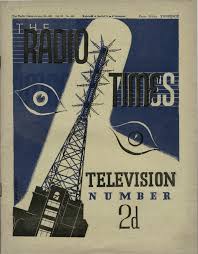
Tuesday 25th August 1936 The fist ever television programmes in Britain , as opposed to tests, were aired at the Olympia Radio exhibition.  They began with a watching eye shown on screen with accompanying music to allow the system to be adjusted before the public was admitted at noon. Two one and a half programmes daily were sent out by the BBC's transmitter at Alexandra Palace. The programmes featured light entertainment items, such as the Three Admirals close harmony group, tap-dancing and humour in the shape of the Griffith Brothers comedy horse "Pogo." More heavyweight culture was represented by "Cover to Cover" with Somerset Maugham, Julian Huxley, "Sapper", T.S . Eliot, Rebecca West and A. P Herbert. The Gaumont British News covered the current affairs base.